What the robot can see, how fast it decides, and how much handholding it takes to cope when the real world refuses to be perfect. Mixed-SKU pallets, packed trailers, glossy fillets and shifting product all expose the gap between a cell that works in a demo and one that can get close to 100% success on challenging tasks.
Fizyr OS 3.0 is built to close that gap.
The release upgrades the vision brain behind the robot in four areas: smarter picking, wider sight, adaptive motion, and a faster path from first API call to production.
Fizyr OS 3.0 is built to improve capabilities in pick and place use cases, provide deeper integration with cameras to provide solve more complex problems, and to just make system integrator’s design and launch processes easier.
Most robots pick one item at a time. Not because one is optimal, but because knowing when several items can be lifted together, without a collision, a dropped box or a shifted load, is hard. That leaves integrators with two poor options: hard-code a rigid pick pattern that only works for very predictable loads, or play it safe with single picks and leave throughput on the table.
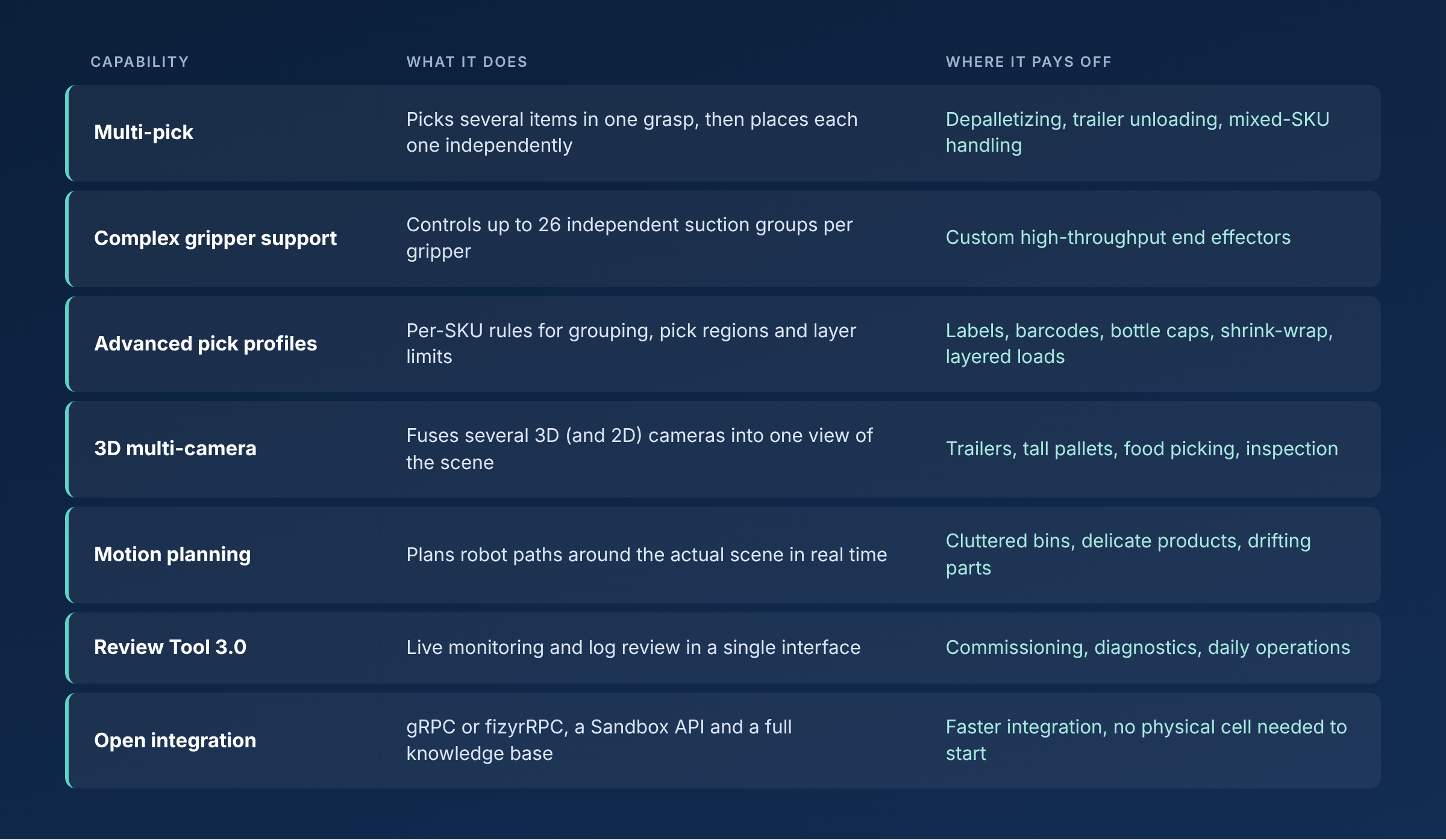
Fizyr OS 3.0 reads the whole scene at once. It works out which items can be grasped together, flags the risky combinations, and makes the call before the robot moves. A single gripper can lift several items in one pose and still place each one independently. In some cases that increases throughput up to four times, with a vision cycle that can be as fast as 20–40ms.
We’re seeing success today in depalletization. Multi-pick is running in production today, using custom grippers with six suction groups. The same scene understanding drives pattern depalletizing: recognizing how a load is arranged and clearing it in coordinated passes instead of box by box.
Higher throughput often means more sophisticated end effectors. Fizyr OS 3.0 fully supports vacuum grippers with up to 26 independently activated suction groups, each with its own geometry and collision behavior.
Grippers with fewer than 20 groups configure in under 30 minutes on first setup.
Pick profiles give integrators deterministic control per SKU, without retraining the AI:
The result is consistent, predictable behavior across product mixes, and fewer hours spent hand-coding pick sequences every time a new pallet configuration arrives.
A single camera, 2D or 3D, sees the scene from one angle. For many cells that is enough. But a loaded trailer, a tall mixed pallet or a tray of fish fillets has geometry one viewpoint cannot capture. Edges hide, faces are occluded, and the robot is left to guess.
Fizyr OS has always been able to take input from multiple cameras. Release 3.0 upgrades that to full 3D multi-camera management: several 3D cameras at different angles combined into one unified view of the scene. 3D cameras can also be paired with 2D cameras, so the system gets shape from one and color and texture from the other.
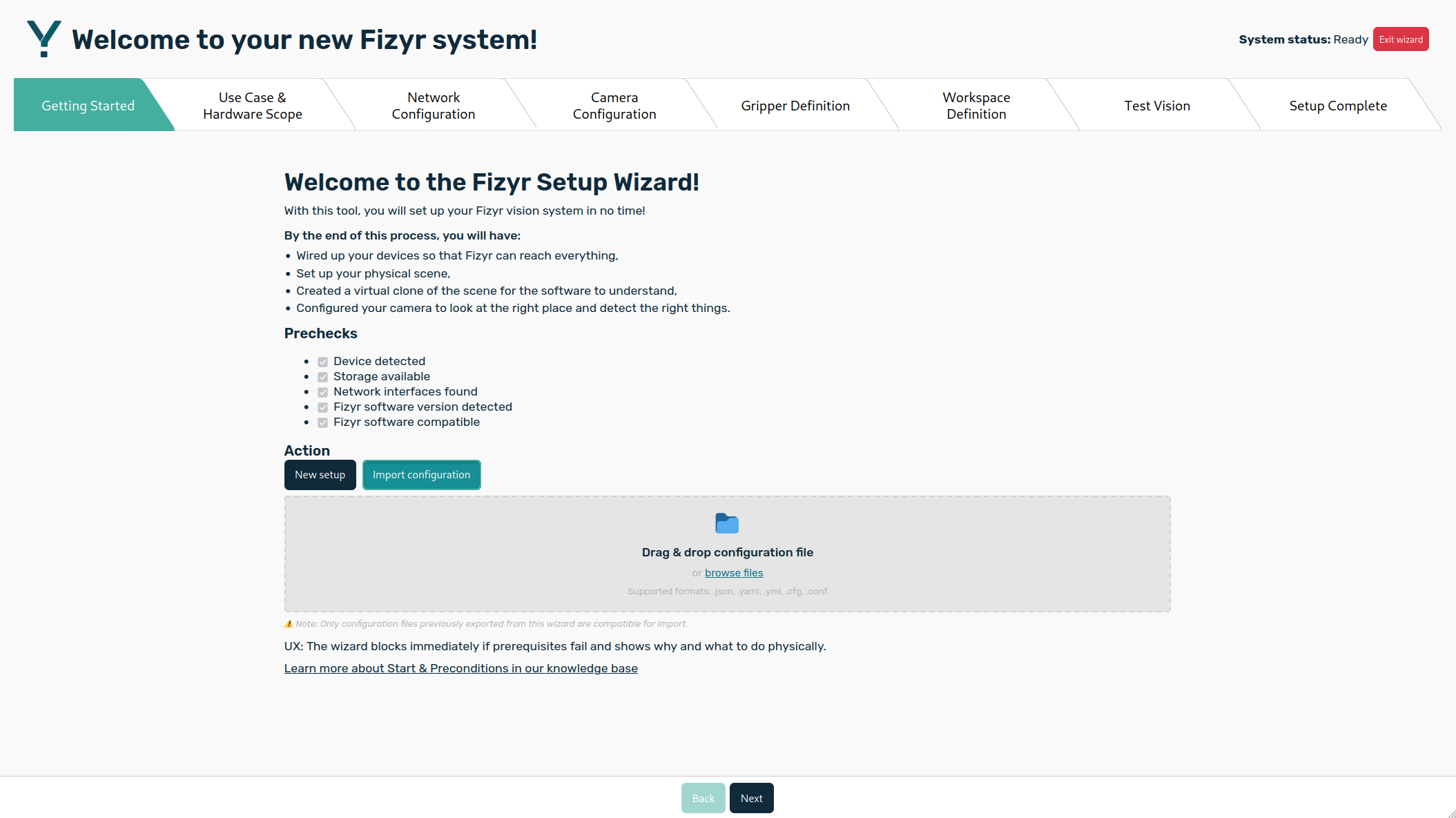
You don't need a separate vision system per camera; Fizyr OS orchestrates everything in the cell, and the new Fizyr UI shows every connected 2D and 3D camera.
Where it matters most:
More viewpoints mean fewer blind spots to design around, and cells that can be trusted with real-world scenes rather than carefully staged ones. See more. Miss less.
In many first-cell projects, integrators spend weeks programming safe paths for every product, bin and layout.
Then a shifted box or an unexpected obstacle stops the line, and every SKU change means going back in to modify configuration and test.
Fizyr OS 3.0 includes a major upgrade to its motion planning module. Instead of following rigid, pre-programmed paths, the robot plans its motion around what the vision system actively sees in the scene, the bin, on the conveyor or on the line, foreign objects and more. This means a system can take inputs from the vision system to manage chaos, deal with changing environments, such as:
For integrators, that means shorter commissioning, less downtime, and automation that is flexibile and can be utilized for jobs once considered too unpredictable for robots.
The refreshed Fizyr Review Tool brings live monitoring and historical log inspection into a single interface. Live mode updates continuously with the latest captured data, while deeper log review helps teams find issues and diagnose system behavior. Capabilities that used to live in separate tools are now in one place, from commissioning through daily operations.
Fizyr OS 3.0 lets integrators work in the stack they prefer. It supports two communication protocols side by side:
The new Sandbox API returns valid responses to real API calls with no physical cell required, so software integration can start on day one. With the published proto files, a typical integration takes around three person-days.
Behind it all is the new Fizyr Knowledge Base, built from our broad experience working with robot and system integrators, industrial camera & sensor companies, and warehouse and plant management teams worldwide. It covers cell design (camera placement, lighting, fiducials), hardware and edge compute requirements, a Python SDK with worked examples, service documentation, NVIDIA simulation workflows for validating picks virtually, fleet management, and operator tools.
Already running Fizyr OS 2.0? Release 3.0 is a major version with new APIs, so client calls need to move to the new protocols. Fizyr handles the one-time configuration migration, and the upgrade path is documented step by step in the Knowledge Base.
Taken together, Fizyr OS removes the trade-offs that have held vision-guided automation back: speed versus safety in picking, coverage versus complexity in camera setups, and flexibility versus commissioning time. Cells become faster to build, easier to tune and more resilient when the load, the product or the layout changes.
Ready to see what Fizyr OS 3.0 vision can do in your next cell?