
By Fizyr Product Manager Salah Alshaal
Hardware agnostic vision is a claim that must be earned
Integrators choose their own cameras. They choose based on price, lead time, ingress rating, the vendor they already have a service contract with, and the space left in the cell.
Fizyr OS must perform. Being flexible carries an engineering bill.
Vision performance depends on what the sensor delivers under working conditions, and datasheets do not tell the full picture. Take for example a camera that has a good-quality point cloud; moving the camera 40 cm higher on the factory floor can reduce its performance on polybags or taped or glossy items, or occlusion becomes an issue.
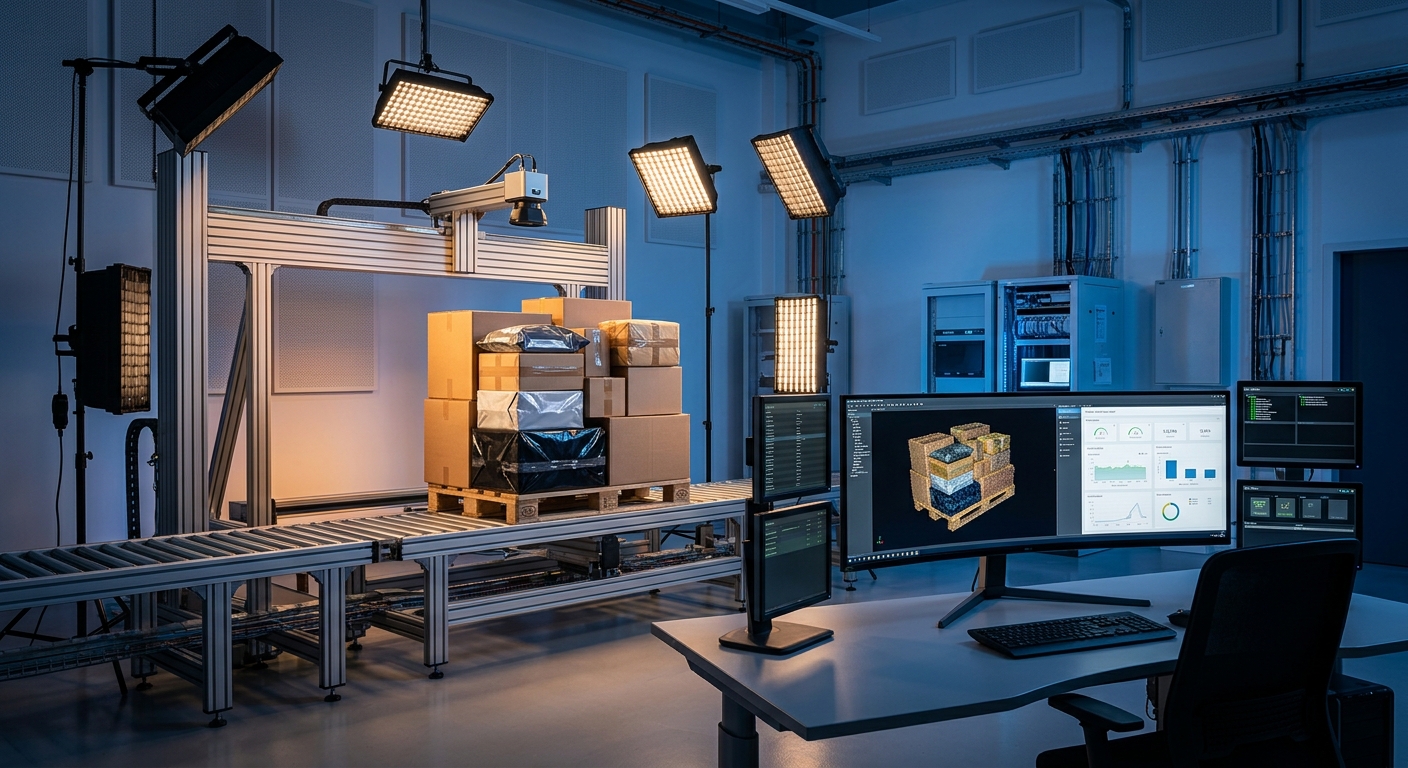
That's why at Fizyr we ensure every camera we support goes through a continuous certification before it reaches a customer site and stays in test afterwards.
What certification measures:
Together, these tests certify the hardware agnostic architecture itself. Every sensor added to the supported list is evidence that the architecture holds.
An agentic lab, running on local models
The philosophy of Fizyr centers around the capability of local AI being essential at the heart of industrial products. And that's why the certification system was built around local agents.
The flow starts with our engineers defining the camera test targets, and agents plan the test matrix, drive the capture rig, run the workloads through Fizyr OS, score the output, diff results against stored baselines, write the report, and raise issues on what failed. Overnight runs are normal and daily check-ins become part of the quality culture.
The models run locally, on our own hardware, in our own lab. Three reasons for that choice:
MCP as the interface between agents and the lab
Our camera testing hardware is exposed as an MCP server: camera control, the motion, lighting and mounting rig, the dataset store, the Fizyr OS benchmark runner, the scoring stack, and reporting. Agents reach all of it through one protocol.
The practical payoff is in supporting new sensors; engineering must build a thin MCP layer on top of the camera's API, once that's complete, the test logic, scoring and reporting can stay the same. The certification pipeline grows sideways instead of being rebuilt for each vendor.
The same tools are available to our engineers directly. Anyone on the team can pull a capture, rerun a scoring job, or query historical results with the tooling the agents use.
Loop engineering keeps the production fleet honest
Certification has a shelf life and recertification is required in various scenarios. For example:
Loop engineering closes the recertification effort gap. Every certified camera stays in the test loop for as long as it is in the production fleet: the suite reruns against stored datasets and against the physical rigs, and regressions surface as a diff against the certified baseline. Problems get caught before a release reaches a running cell.
What partners get out of it
Faster answers, justified by data.
When an integrator asks whether a specific uncertified camera will work for a specific cell, at a specific height, on a specific product mix, we can answer in days with data rather than with an educated guess. Known limits get documented up front, so hardware decisions happen in the design phase instead of during commissioning.
Why we build our own tooling
Fizyr sells ultra-fast and performant vision software. The engineering standard we apply to Fizyr OS is the standard we apply to the systems that build and validate it. Agentic AI, local models, and MCP are in production inside our own engineering workflow.


