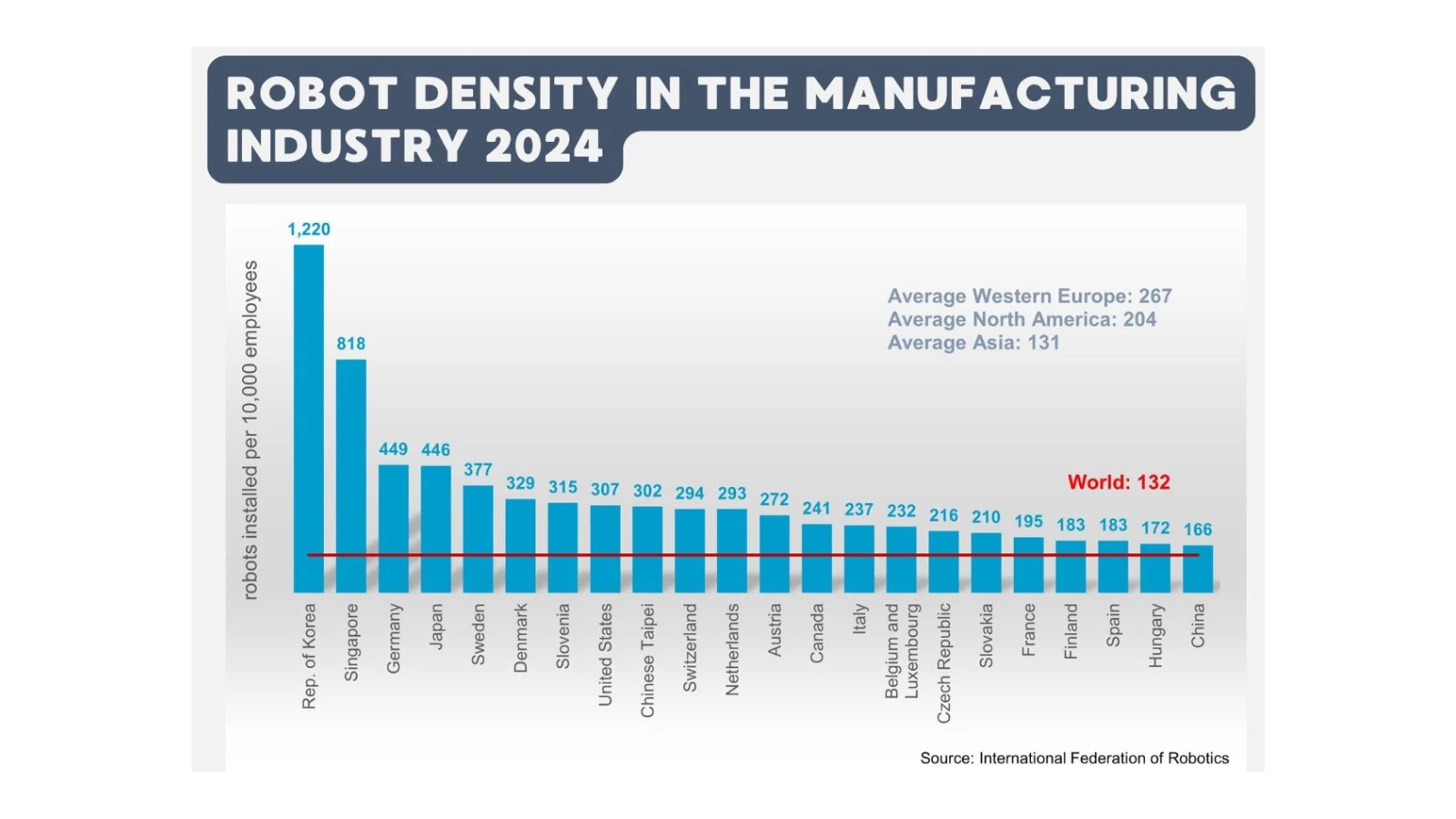

Western Europe now averages 267 robots per 10,000 manufacturing employees, ahead of North America at 204 and Asia at 131. South Korea leads all nations at a striking 1,220 robots per 10,000 workers. The direction of travel is unambiguous: automation is accelerating across every major industrial economy. But raw installation numbers only tell part of the story.
As robot density climbs, the limiting factor in many operations is no longer the mechanical arm - it's the perception layer behind it.
Robots can move with extraordinary speed and repeatability, but without reliable vision, they remain dependent on highly structured environments, narrow product ranges, and costly human supervision. This limits the usecases and scenarios in which automation can solve the difficult problems. The real opportunity in supply chain, food processing and manufacturing lies in making the robots genuinely capable of seeing and understanding their environment.
Logistics: Handling Variability at Scale
Modern logistics operations deal with an enormous range of parcel shapes, sizes, labels, and packaging materials flowing through the same sortation infrastructure. Trailer unloading, singulation, and induction onto conveyor systems all require real-time recognition of items that were never catalogued in advance. A vision system that can only handle a predefined SKU set, creates bottlenecks the moment volume spikes or a new shipper comes on board.
The Fizyr OS approach to logistics automation is built around exactly this problem: enabling robots to handle unstructured, high volume, high variety inbound streams without manual intervention. Whether items arrive on a conveyor, on pallets, or in roller cages, the vision layer identifies, segments, and targets each object for picking and placement — at the speed and throughput that high-volume logistics demands.
Food Processing: Precision in a Perishable Environment
Food processing presents some of the most demanding conditions for vision-guided automation. Products are irregular in shape, highly variable in appearance, and subject to rapid change — a chicken breast on a trim line looks nothing like the next one. Add in the constraints of food-safe environments (wet, fast-moving, heavily regulated), and the bar for reliable vision becomes very high.
The opportunity here is significant. Vision AI can segment and classify food items for picking and placement, detect quality issues and spoilage in real time, and guide cutting or trimming operations that previously required skilled manual labor. Systems capable of processing frames in under 20ms and operating at near-perfect accuracy, unlock automation in zones that were considered too difficult for robotics even a few years ago.
Manufacturing and Industrial Inspection
In manufacturing, the density growth reported by IFR, reflects automation spreading beyond automotive and electronics — sectors that have led for decades — into a broader base of industrial applications. Vision plays an increasingly central role here too: inline inspection of seals, labels, and product quality; guidance for assembly operations; and real-time anomaly detection that allows defects to be caught before they cascade downstream.
The move from rule-based machine vision to AI-driven perception is particularly consequential in manufacturing. Where earlier systems required extensive re-engineering for every product variant, modern vision platforms can adapt across configurations with far less integration overhead.
The Perception Gap
The IFR data makes clear that industrial automation is entering a new phase of scale. What it also implies — though less explicitly — is that the technical debt accumulated in first-generation automation will become increasingly visible. Lines designed around rigid, structured environments will struggle to keep pace with the product variety and throughput expectations that modern operations demand.
The opportunity for vision-guided automation isn't simply to add capability at the margin. It's to fundamentally expand the envelope of what robotics can handle — bringing human-level adaptability to picking, handling, and inspection tasks across the most demanding industrial environments.
Read the full article here.
.jpg)

.jpg)