
Vision hardware
Fizyr OS runs on modern edge computing technology, managed by our high performance, cost-effective vision servers.
In many automation use cases, the cloud is not an option: performance, security and on-site control mean hardware resources need to be local for robotics installations in warehouses, factories and food processing facilities. In today’s competitive environment for computing resources that means understanding the pros, cons and costs of acquiring and managing hardware for local systems. One of the growing challenges we’re seeing is in acquiring cost effective GPUs and CPUs, affected by growing demand and ongoing geo-political factors.
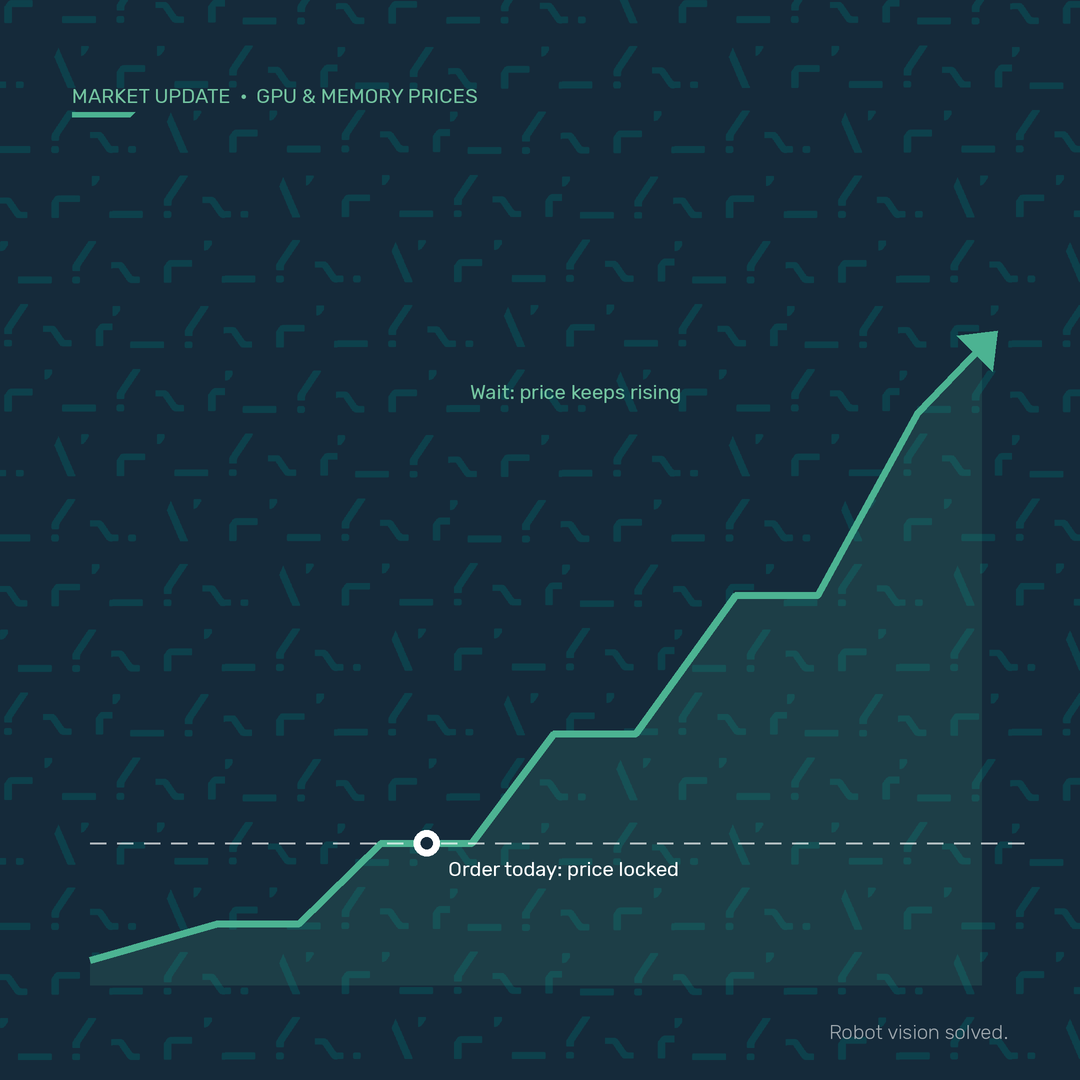
If you're planning a vision-guided robotic cell for 2027, the best time to order the vision hardware is when you have won the project. GPU and memory prices have almost doubled in a short period and the market expects them to keep climbing. The quotes you make today will be out of date within the month.
What's happening in the market?
AI data centers are buying memory faster than the industry can produce it. Manufacturers are shifting their most advanced capacity to high-margin server and AI products, leaving less for everyone else - including the industrial PCs and GPUs that power robot vision.
GPUs feel this directly. Memory now accounts for more than 80% of the bill of materials for high-end GPUs, and partner versions of Nvidia's RTX 5090 already sell above $3,000 (Astute Group).
And it is still accelerating. On 12 October 2026, Tech Times reported "GPU Prices Jump Again as AMD Radeon Loses Its Last Affordability Buffer": AMD raised memory kit prices for its board partners from 1 October, Nvidia RTX 50-series cards cost on average 66% more than a year ago, and GDDR6 spot prices have roughly tripled since late 2025. In October alone, 59 of 81 monitored GPUs got more expensive.
Why does this matter for vision-guided projects?
Vision intelligence turns camera data into pick decisions in real time and relies on GPU-equipped industrial PCs with sufficient memory and storage. When those components get more expensive and harder to source, projects are affected in three ways:
What we recommend
The market is moving fast, but you are not powerless. A few planning choices made now can protect your budget, your delivery date and your competitive edge. These are the steps we recommend to every customer planning a vision-guided deployment in the next year:
The automation case for vision-guided robotics has never been stronger. The only thing that has changed is the cost of waiting.
-2.png)
.jpg)

.jpg)