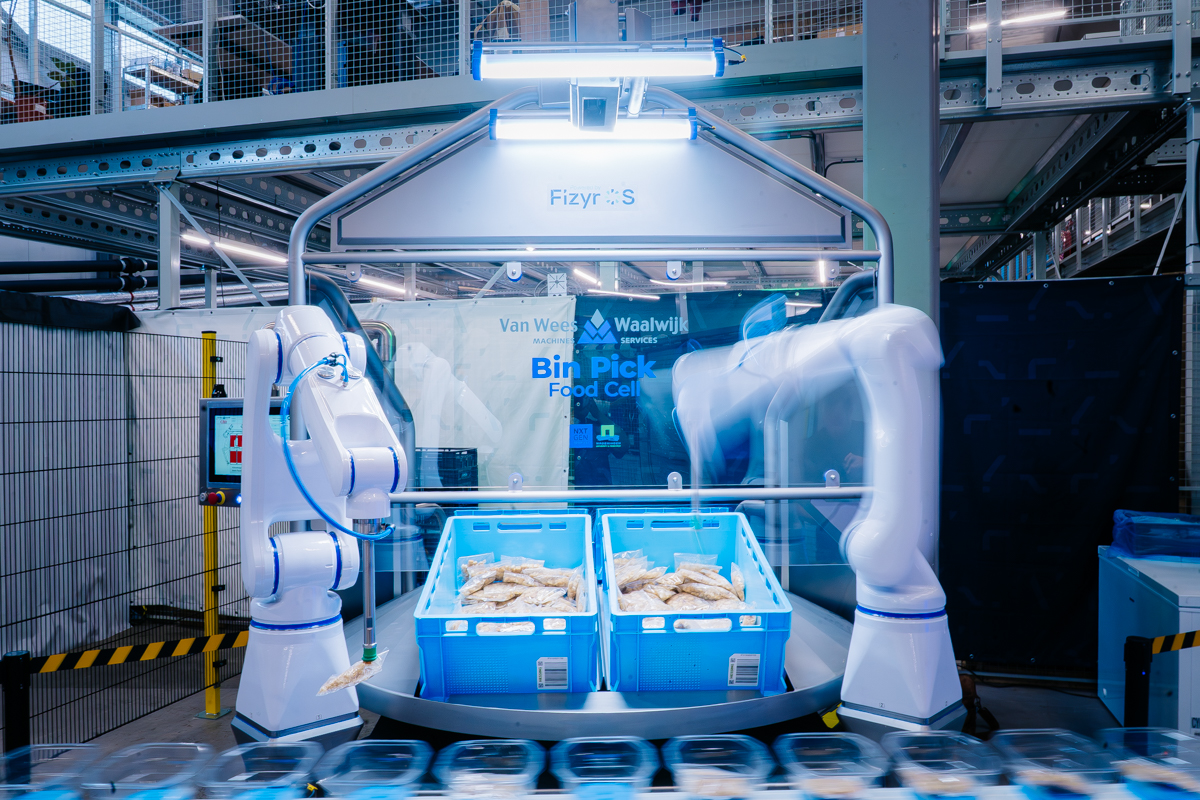

Fizyr is often asked a version of the same question: when is 'simple vision' enough - and when do you need something more advanced? Across industries and use cases, the answer varies, but the decision framework is surprisingly consistent.
So here's a practical way to think about it.
We’re simplifying a bit here, but if you run your specific automation task through these five questions, and answer "yes" to two or more, it's a strong signal you should be looking at an advanced vision solution to power your process.
1. High Variability
Does the ‘standard’ version of your item look different every time, or at least vary enough where you can’t standardize on a handful images that represent the entire visual data set?
This is common in pick-and-place applications across manufacturing, logistics and food processing, where items differ in shape, size or appearance.
2. Subjective Quality in Defect Detection
Are defects described in terms like 'scratched', 'dented', or 'ugly' rather than specific measurements like '2 mm deviation'?
Again, variability is a consideration. In many inspection scenarios - damaged packages, imperfect produce or inconsistent food products - there are too many ways somtehing can go wrong to define with fixed rules. These cases demand vision intelligence that can interpret visual nuance, not just measure it by a few examples.
3. Unstructured Environments
Do items arrive in random orientations - piled, in bins, stacked unpredictably, or under changing lighting conditions?
Simple vision systems (and even human operators) struggle in these environments. Advanced vision AI systems are designed to detect, segment and understand object in exactly these messy, real-world conditions.
4. False Rejects
Does your current system frequently flag good items as defective due to shadows, dust, or other minor inconsistencies?
False positives drain time, reduce throughput and create unnecessary manual intervention. Vision systems with mature machine learning capabilities and high quality industrial cameras can distinguish meaningfucl defects from irrelevant noise with far greater precision.
5. Complexity that comes with Scale and Variability
Are you dealing with dozens or even hundreds of product variations, each requiring it' own inspection logic?
Simple vision systems quickly becom unmanageable as variabilty increases. Fast, intelligent vision systems scale far more effectively, adapting across product types without the need for constant manual reconfiguration.
--------------------
In practice, many automation challenges involve a combination of these factors. That's why Fizyr's intregration partners are often called in tot replace vision systems that struggle with one - or several - of these limitations.
The takeaway is simple: if your process involves variability, subjectivity, unstructured inputs or scale; simple vision will probably not be enough. That's where intelligent vision AI makes the difference between as system that works in theory - and one that works in the real world.
We’d love to help you take your automation to the next level with smarter, more capable machine vision. Let’s explore your challenges together and identify the right solution tailored to your needs.
Get in touch today to discuss your project and see what’s possible.
.jpg)

.jpg)